< Más Articulos : Is Christianity Reform Judaism? (Times of Israel - 1 Jan 2026)
-
-
Is Christianity Reform Judaism? (Times of Israel - 1 Jan 2026)

It is undeniable that Judaism is foundational to the formation of Christianity. A substantial portion of Christianity’s theological, moral, and philosophical framework is rooted in the Torah and the broader Hebrew Scriptures, preserved within Christian tradition as the Old Testament. Core concepts such as covenant, law, prophecy, and ethical monotheism originate in Jewish scripture and thought.
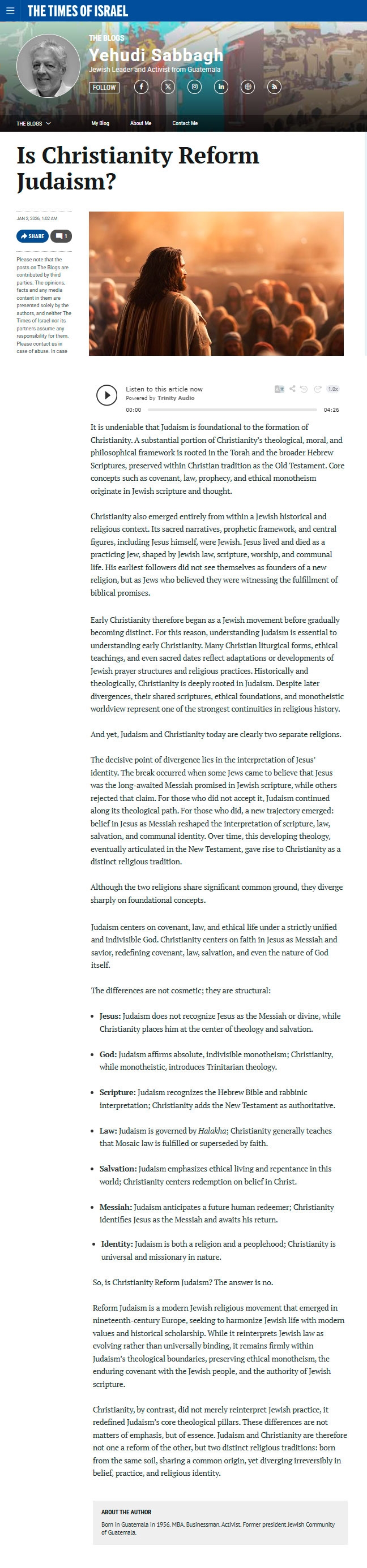
Christianity also emerged entirely from within a Jewish historical and religious context. Its sacred narratives, prophetic framework, and central figures, including Jesus himself, were Jewish. Jesus lived and died as a practicing Jew, shaped by Jewish law, scripture, worship, and communal life. His earliest followers did not see themselves as founders of a new religion, but as Jews who believed they were witnessing the fulfillment of biblical promises.
Early Christianity therefore began as a Jewish movement before gradually becoming distinct. For this reason, understanding Judaism is essential to understanding early Christianity. Many Christian liturgical forms, ethical teachings, and even sacred dates reflect adaptations or developments of Jewish prayer structures and religious practices. Historically and theologically, Christianity is deeply rooted in Judaism. Despite later divergences, their shared scriptures, ethical foundations, and monotheistic worldview represent one of the strongest continuities in religious history.
And yet, Judaism and Christianity today are clearly two separate religions.
The decisive point of divergence lies in the interpretation of Jesus’ identity. The break occurred when some Jews came to believe that Jesus was the long-awaited Messiah promised in Jewish scripture, while others rejected that claim. For those who did not accept it, Judaism continued along its theological path. For those who did, a new trajectory emerged: belief in Jesus as Messiah reshaped the interpretation of scripture, law, salvation, and communal identity. Over time, this developing theology, eventually articulated in the New Testament, gave rise to Christianity as a distinct religious tradition.
Although the two religions share significant common ground, they diverge sharply on foundational concepts.
Judaism centers on covenant, law, and ethical life under a strictly unified and indivisible God. Christianity centers on faith in Jesus as Messiah and savior, redefining covenant, law, salvation, and even the nature of God itself.
The differences are not cosmetic; they are structural:
Jesus: Judaism does not recognize Jesus as the Messiah or divine, while Christianity places him at the center of theology and salvation.
God: Judaism affirms absolute, indivisible monotheism; Christianity, while monotheistic, introduces Trinitarian theology.
Scripture: Judaism recognizes the Hebrew Bible and rabbinic interpretation; Christianity adds the New Testament as authoritative.
Law: Judaism is governed by Halakha; Christianity generally teaches that Mosaic law is fulfilled or superseded by faith.
Salvation: Judaism emphasizes ethical living and repentance in this world; Christianity centers redemption on belief in Christ.
Messiah: Judaism anticipates a future human redeemer; Christianity identifies Jesus as the Messiah and awaits his return.
Identity: Judaism is both a religion and a peoplehood; Christianity is universal and missionary in nature.So, is Christianity Reform Judaism? The answer is no.
Reform Judaism is a modern Jewish religious movement that emerged in nineteenth-century Europe, seeking to harmonize Jewish life with modern values and historical scholarship. While it reinterprets Jewish law as evolving rather than universally binding, it remains firmly within Judaism’s theological boundaries, preserving ethical monotheism, the enduring covenant with the Jewish people, and the authority of Jewish scripture.
Christianity, by contrast, did not merely reinterpret Jewish practice, it redefined Judaism’s core theological pillars. These differences are not matters of emphasis, but of essence. Judaism and Christianity are therefore not one a reform of the other, but two distinct religious traditions: born from the same soil, sharing a common origin, yet diverging irreversibly in belief, practice, and religious identity.
https://blogs.timesofisrael.com/is-christianity-reform-judaism/
( Por: Yehudi Sabbagh , 01/01/2026 )